
 Post by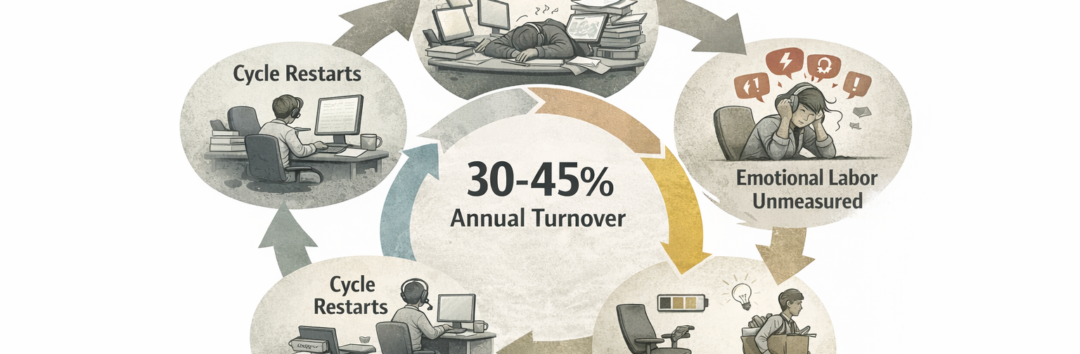
The Burnout Epidemic: Why Customer Support Agents Are Leaving in Droves
They don’t quit because they’re weak. They quit because the job is structurally impossible.
The Statistic That Should Concern Every Business Leader
Customer support agents are leaving their jobs at alarming rates. Industry data shows call center turnover rates ranging from 30 to 45% annually[1][2], more than double the average for most other occupations. In India specifically, the BPO sector has attrition rates around 30 to 35% in 2025[3].
Not because they found better opportunities. Not because they got promoted. Not because they’re lazy or uncommitted.
They quit because they’re burned out. Mentally exhausted. Emotionally depleted. Physically drained.
And here’s the brutal truth: The best agents quit first. The ones who care deeply, who feel every customer’s frustration personally, who stay late to solve problems are the first to break. Because empathy is expensive. And the current system extracts it mercilessly.
What Burnout Actually Looks Like
Burnout isn’t just “feeling tired.” It’s not fixed with a day off or a team lunch. It’s a chronic state of physical, emotional, and mental exhaustion caused by prolonged stress that exceeds a person’s capacity to cope[4].
For customer support agents, burnout shows up as:
Physical Symptoms: Chronic fatigue (even after sleeping), headaches and muscle tension, disrupted sleep (waking up anxious about work), getting sick more frequently, and stress related health issues[5].
Emotional Symptoms: Feeling numb or detached from customers, dreading the start of each workday, irritability and mood swings, crying or feeling overwhelmed, and a sense of helplessness and defeat[5].
Behavioral Symptoms: Withdrawing from colleagues, decreased performance despite trying hard, cynicism (“nothing I do matters anyway”), increasing mistakes and errors, and calling in sick more often[5].
This isn’t weakness. This is a normal human response to an impossible situation.
The Vicious Cycle That Traps Everyone
Here’s how the burnout epidemic perpetuates itself:
Step 1: Impossible Workload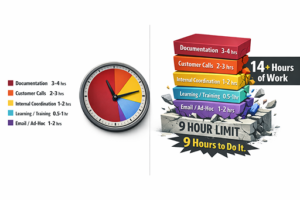
A customer support agent’s job requires significant work crammed into limited hours:
3 to 4 hours: Post call CRM documentation, notes, logs, ticket updates
2 to 3 hours: Handling 20 to 25 customer calls or chats
1 to 2 hours: Internal coordination (chasing engineering, finance, product teams for escalations)
0.5 to 1 hour: Learning new features, policy updates, product changes
1 to 2 hours: Email follow ups, ad hoc requests, “quick questions” from managers
The math doesn’t work. It has never worked.
Step 2: Emotional Labor Goes Unmeasured
Beyond the time, there’s the invisible emotional cost: absorbing anger that isn’t theirs, staying calm when customers yell, apologizing for problems they didn’t cause, maintaining enthusiasm on the 25th repetitive call, and carrying the weight of every unresolved ticket home.
This emotional labor is unpaid, unrecognized, and unsustainable.
Step 3: High Performing Agents Burn Out First
The agents who care most feel it hardest. They stay late to solve that one customer’s problem, take ownership of issues beyond their control, and genuinely want to help, even when the system won’t let them. Their empathy becomes their breaking point[6].
Step 4: Agents Quit
After months of this grind, agents leave. Not because they’re bad at the job—often they’re great at it. They leave because they can’t sustain the pace without destroying their mental health. Research shows that workers ages 20 to 34 stay with a call center only about a year on average, compared to up to 2.7 years in other industries[7].
Step 5: The Cycle Restarts
Now the company has to hire new agents (recruitment costs), train them for 3 to 4 weeks (training costs plus lost productivity), wait 3 to 6 months for them to reach full efficiency, watch institutional knowledge disappear, and repeat the cycle again.
The attrition cycle costs companies significant money while simultaneously destroying employee wellbeing.
The Three Root Causes of Support Agent Burnout
- The Repetitive Query Trap
70 to 80% of customer support queries are repetitive: “I forgot my password,” “Where’s my order?,” “How do I change my billing information?,” “Why was I charged twice?,” “How does [basic feature] work?”
These questions are important to customers. But they don’t require human intelligence or empathy to solve. They need fast, accurate answers.
Yet agents spend 6+ hours a day answering these same questions over and over. By 3 PM, they’ve explained password resets 14 times. They’re mentally exhausted. And the complex problems that actually need human attention? They tackle those in a state of depletion.
- The Documentation Time Sink: After every interaction, agents must write detailed CRM notes, log call summaries, update ticket statuses, tag customer sentiment, record resolution steps, and note next actions.
This takes 5 to 7 minutes per interaction. If an agent handles 25 calls a day, that’s 2 to 3 hours of pure documentation work. Not helping customers. Not solving problems. Just recording what already happened.
This is soul crushing busywork.
- The Zero Context Nightmare: Customer calls in with a problem. Speaks to Agent A. Gets transferred to Agent B. “Hi, can you explain your issue?” The customer has to repeat everything. Agent B has no history, no context, no record of what was already discussed. This happens multiple times per day[8].
For the agent, it’s embarrassing. For the customer, it’s infuriating. For the business, it’s expensive. The system fails everyone simultaneously.
What This Costs (And Why It Matters)
The Human Cost
Let’s be clear: This is about people, not just productivity. When a 24 year old agent has anxiety attacks before their shift starts, that’s a human failing, not a business metric. When someone cries in the bathroom between calls, that’s a person in pain, not a performance issue.
We’re extracting wellbeing from people to run a system that doesn’t have to work this way.
The Business Cost
But even if you only care about the bottom line, burnout is expensive. Research shows 63% of call center agents experience burnout[9], contributing to a 30 to 50% annual turnover rate. The cost of replacing and retraining workers is estimated to be 30 to 50% of an employee’s annual salary[9].
For a 10 agent support team:
Annual cost of team: ₹2.5 to 4.3 lakhs per agent[10][11] (approximately ₹25 to 43 lakhs total for tier 1 cities)
Average attrition rate: 30 to 45% annually[1][2]
Agents who quit per year: approximately 3 to 4 agents
Replacement cost per agent: ₹50,000 to ₹1,00,000 (recruiting plus training)
Productivity loss during transition: approximately 3 months per replacement
Total hidden cost of attrition: ₹10 to 15 lakhs per year
This doesn’t include lost institutional knowledge, decreased customer satisfaction during training periods, manager time spent on hiring and training, damage to team morale when colleagues quit, or reputation damage from poor customer experiences.
The Customer Cost
When agents are burned out, response quality drops (rushed, incomplete solutions), wait times increase (understaffed teams), empathy disappears (agents are too depleted to care), mistakes multiply (exhaustion leads to errors), and customers churn silently (they stop calling and just leave).
Replacing a customer costs 5 to 25 times more than retaining one.
Why Hiring More Agents Doesn’t Fix This
The instinctive response to burnout is: “We need more people.” But hiring more agents is like adding more buckets to a sinking ship. You’re treating the symptom, not the cause.
Here’s why:
It’s Prohibitively Expensive: Each additional agent costs ₹2.5 to 4.3 lakhs per year (salary plus benefits for tier 1 cities like Bangalore, Mumbai, Delhi)[10][11], ₹50,000+ onboarding and training costs, 3 to 6 months to reach full productivity, and a significant chance they’ll quit within 18 to 24 months. For SMBs and startups, this is a runway killer.
It Doesn’t Address the Root Problem: More agents means more people doing repetitive work, more people drowning in CRM documentation, more people burning out on the same impossible workload, and more attrition. You’re just multiplying the problem.
It’s Not Scalable: As your business grows, support requests grow. So you hire more agents. But support requests keep growing. So you hire more agents. This is a linear, unsustainable scaling model. Eventually, support costs outpace revenue growth.
The Real Solution: Structural Change, Not Staffing Band Aids
The problem isn’t that agents are weak or unprepared. The problem is the system is structurally impossible. To fix burnout, we need to:
- Automate the Soul Crushing Repetitive Work: 70 to 80% of queries don’t need human intelligence. They need instant, accurate answers, 24/7 availability, zero wait times, and consistency.
This is where AI should handle the workload. Not to replace humans, but to free humans from work that destroys them.
What AI should handle: Password resets, order tracking, FAQs and how to queries, basic troubleshooting, appointment scheduling, and information lookups.
What humans should handle: Complex technical problems, emotionally sensitive situations, edge cases and exceptions, high value customer relationships, and strategic problem solving. - Eliminate the Documentation Burden: AI can transcribe calls in real time, generate summaries automatically, update CRMs with zero manual work, create tickets with full context, and log everything without human effort.
This gives agents back 3 to 4 hours per day. That’s 3 to 4 hours to actually help customers, not document that they helped customers.
- End the Zero Context Nightmare: AI can retrieve full customer history instantly, provide context to human agents when escalating, remember past issues, emotions, and resolutions, and ensure no customer ever has to repeat themselves.
This transforms the customer experience and makes the agent’s job possible.
What Happens When You Fix the System
Let’s imagine two parallel universes:
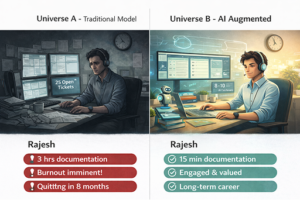
Universe A: Traditional Model (Current Reality)
Agent: Rajesh, 26, Bangalore
- Works 9 to 10 hours daily, paid for 9
- Handles 25 tickets per day
- Spends 3 hours on CRM documentation
- Answers the same 10 questions 60% of the time
- Feels exhausted, undervalued, and stuck
- Plans to quit in 8 months
- Company will spend ₹75,000 to replace him
Universe B: AI Augmented Model (Possible Future)
Agent: Rajesh, 26, Bangalore
- Works exactly 9 hours, rarely stays late
- Handles 8 to 10 complex tickets per day (AI handles 15 to 17 simple ones automatically)
- Spends 15 minutes on documentation (AI does the rest)
- Focuses on problems that need human expertise
- Feels valued, impactful, and engaged
- Sees this as a long term career
- Company retains him for 4+ years
Same person. Same skills. Completely different outcome.
The Path Forward
The burnout epidemic isn’t inevitable. It’s the result of a broken system that we’ve accepted as normal. But it doesn’t have to be this way.
We can build customer support systems where agents work sustainable hours, repetitive work is automated rather than assigned to humans, empathy is preserved for situations that need it, mental health is protected rather than sacrificed, and careers are built rather than burned out.
This isn’t about replacing humans with AI. It’s about using AI to make human work humane again.
The Bottom Line
Agents are leaving at rates of 30 to 45% annually because we’re asking them to do a job that’s structurally impossible. Research shows 63% of call center agents experience burnout[9], and 87% report high or very high stress levels[12].
The question isn’t “How do we make agents tougher?” The question is “Why are we still running systems that guarantee burnout?”
Because the alternative exists. The technology is here. The solution is proven. What’s missing is the decision to change.
And for every month we delay, we lose more talented, empathetic, dedicated people who deserved better from us.
References
[1] Insignia Resources. (2025). “Call Center Turnover Rates | 2025 Industry Average.” https://www.insigniaresource.com/research/call-center-turnover-rates/
[2] AmplifAI. (2024). “Call Center Turnover: Causes, Formulas, and Strategies to Reduce It.” https://www.amplifai.com/blog/call-center-turnover
[3] Wisemonk. (2025). “Managing Attrition in India 2025: A Complete Guide.” https://www.wisemonk.io/blogs/managing-attrition-in-india
[4] Psychology Today. “Burnout.” Referenced in Giva. https://www.givainc.com/blog/helpdesk-call-center-burnout-signs-prevention/
[5] BoldDesk. (2025). “8 Tips to Prevent Customer Service Burnout.” https://www.bolddesk.com/blogs/customer-service-burnout
[6] Creovai. “Reduce Customer Service Burnout with Smart Tools.” https://www.creovai.com/blog/customer-service-burnout
[7] OvationCXM. (2018). “Customer Service Burnout: Why, When, & How to Minimize Agent Turnover.” https://www.ovationcxm.com/blog/minimize-agent-turnover
[8] SQM Group. “Call Center Burnout Rate Problem: Defining, Measuring, and Tips for Recovering From It.” https://www.sqmgroup.com/resources/library/blog/call-center-burnout-rate-problem
[9] Nextiva. (2025). “What Is Call Center Burnout? How To Prevent & Overcome It.” https://www.nextiva.com/blog/call-center-burnout.html
[10] PayScale. (2025). “Customer Service Agent Salary in India.” https://www.payscale.com/research/IN/Job=Customer_Service_Agent/Salary
[11] Indeed. (2025). “Customer service representative salary in India.” https://in.indeed.com/career/customer-service-representative/salaries
[12] GetVoip. “Call Center Burnout: Causes & How to Overcome It.” https://getvoip.com/blog/call-center-burnout/